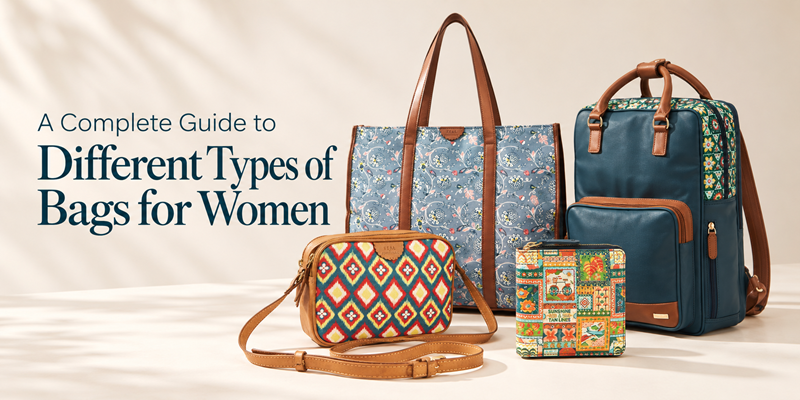
Different types of bags for women serve different purposes. Tote bags offer room for everyday belongings, sling bags keep small essentials close, laptop bags organise work devices, clutches suit occasions when you want to carry less, and duffel bags provide space for gym sessions or short trips.
Choosing between them starts with a simple question: what do you need to carry? This guide explores five practical categories of bags for women, including wallets alongside clutches, to help you match a bag to your routine.
1. Tote Bags
A tote bag is a spacious bag with two handles and a wide opening. It is useful when your day involves several activities and you want to keep your belongings together.
Depending on its dimensions, a tote can accommodate a notebook, water bottle, lunch box, and small personal items. Some designs have an open top, while others include a zip or magnetic fastening.
For everyday use, check whether the handles sit comfortably on your shoulder when the bag is full. An inner pocket or removable organiser can prevent smaller items from getting lost at the bottom. If you commute on public transport, a zipped opening helps keep belongings contained.
2. Sling Bags
A sling bag has a single strap and is commonly worn across the body or over one shoulder. Compact styles are useful for errands, casual outings, and days when you only need your phone, keys, and wallet.
Compared with a roomy tote, a small sling limits how much you can carry, which may suit a lighter routine. However, capacity varies between designs.
Look for an adjustable strap and a closure you can operate easily. Check the main compartment against your phone’s dimensions, particularly if you use a bulky case. A separate pocket can keep keys away from your phone screen.
3. Laptop Bags
A laptop bag includes a dedicated compartment for a computer, often with padding and additional pockets for work accessories. It can help organise a charger, mouse, documents, and other office essentials.
Check the laptop compartment’s internal measurements against your device’s width, depth, and thickness. The bag’s overall dimensions do not tell you exactly how much space the laptop pocket provides.
Padding offers cushioning, but it does not make a bag damage-proof. Keep liquids in a separate, secure space where possible. If you regularly carry a charger and documents, check the bag’s weight and strap comfort with those items included. A tote can also serve as a laptop bag when it has suitable padding and a secure compartment.
4. Clutch Bags and Wallets
A clutch is a small bag designed to be carried in the hand, although some styles include a detachable strap. Clutches are useful for dinners, weddings, celebrations, and outings that require only a few essentials.
Before choosing one, check whether it comfortably holds your phone, keys, cards, and any personal items you need. A compact shape may look spacious outside but offer limited room once the clasp and lining are considered.
Wallets belong alongside clutches in this guide, but they are separate accessories. A wallet primarily organises cash, cards, and identification. Some larger wallets include wrist straps and additional storage, making them convenient to carry independently. A wallet-style clutch combines card organisation with space for small outing essentials.
5. Duffel Bags
A duffel bag has a roomy main compartment, carry handles, and often a shoulder strap. It is useful for gym visits, overnight stays, and short trips requiring clothes or other bulky belongings.
The internal layout matters as much as capacity. A separate shoe compartment can keep footwear apart from clothing, while smaller pockets make keys and toiletries easier to locate.
For frequent travel, consider the bag’s empty weight and how comfortable it feels when packed. If you plan to take it into an aircraft cabin, check its packed dimensions against your airline’s current baggage allowance.
Start by laying out the items you carry on a typical day. Then compare bag dimensions, closures, pocket layout, and carrying comfort against that collection. Check the manufacturer’s care instructions, too, especially if the bag will be used frequently.
A useful bag should make your belongings easy to pack, carry, and find. The right choice may change between workdays, casual outings, and weekends away.